GET IN TOUCH TODAY!
"*" indicates required fields

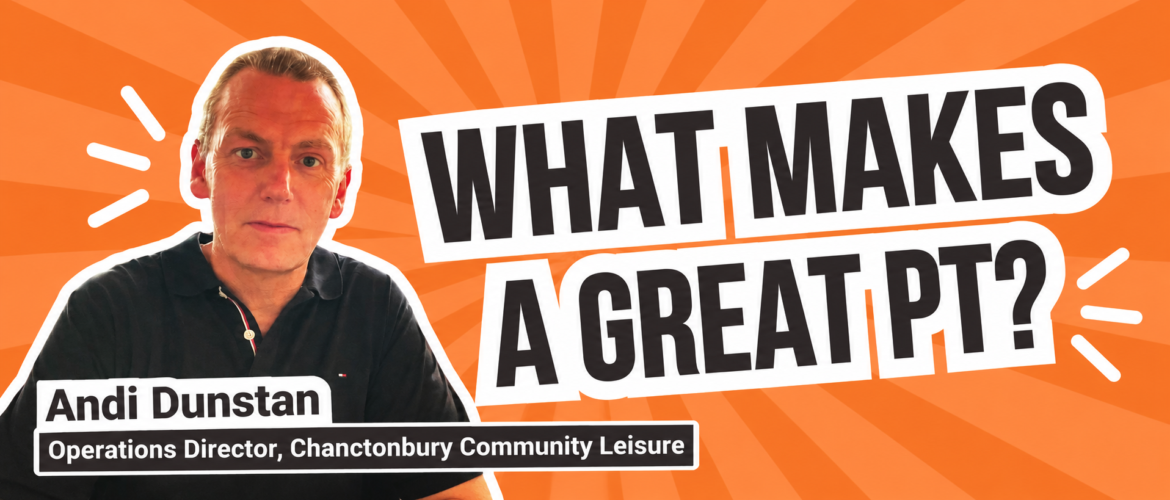
What does it really take to build a successful and rewarding career in health and fitness? Is it qualifications, technical knowledge, confidence, or something else entirely?
I recently sat down with Andi Dunstan, Operations Director at Chanctonbury Community Leisure in Storrington, to draw on his 35-plus years of experience in the leisure industry and explore what really matters when building a successful career in health and fitness.
Andi has done just about everything in the industry, from coaching sport in schools to managing large leisure facilities and helping rebuild Chanctonbury from the brink of closure into a thriving community hub.
So I was keen to pick his brains about what he’s learnt along the way, particularly what separates those who simply work in fitness from those who build successful, rewarding careers.
Interestingly, our conversation kept coming back to something that has very little to do with exercise science, qualifications or fancy marketing strategies.
People.
How you treat them, how you make them feel and whether you genuinely care about helping them.
And as Andi’s experience demonstrates, getting those things right can make an enormous difference.
Andi’s journey into the leisure industry wasn’t exactly conventional.
When he left college, he wanted to pursue a career in sport and leisure. Unfortunately, university courses in sport were few and far between at the time, and entry requirements were particularly demanding.
So he decided to pursue a career working in leisure centres instead.
There was just one small problem.
He couldn’t swim.
Not ideal when one of the traditional routes into leisure was becoming a lifeguard!
Instead, Andi joined an employment training programme that involved visiting schools and teaching water safety.
Over the following 18 months, he gained numerous qualifications, eventually becoming qualified to coach ten different sports.
Remarkably, he even became a swimming teacher before he could swim himself.
He subsequently learnt to swim, qualified as a lifeguard and started his own sports coaching business, delivering activities in schools and running holiday programmes.
From there, his career progressed through sports development and leisure management, eventually taking him into senior operational roles overseeing multiple leisure facilities.
He’s certainly seen a few changes in the industry over those 35 years.
But perhaps his greatest challenge came during the COVID-19 pandemic.
When the organisation operating Chanctonbury Leisure Centre became insolvent during the pandemic, the facility faced an uncertain future.
Andi found himself in the rather unusual position of being responsible for selling off the centre’s equipment.
But while arranging for equipment to be collected during the day, he was also working behind the scenes to secure funding, purchase the equipment and establish a new charitable organisation to reopen the facility.
In April 2021, Chanctonbury reopened its doors.
With zero members.
Imagine that. You’ve got staff to pay, bills to cover and absolutely nobody signed up.
Not exactly the ideal start to a business!
But Andi and his team believed they could build something special.
And when we recorded the podcast, he told me the centre had grown to approximately 2,100 members, with between 20,000 and 25,000 visits every month.
That’s a remarkable turnaround.
So naturally, I wanted to know what Andi attributed that success to.
His answer wasn’t expensive marketing, clever sales tactics or the latest gym equipment.
It was the atmosphere they’d created.
They hadn’t simply reopened a leisure centre. They’d created a community hub where people felt welcomed, comfortable and valued.
And that brings us to one of the biggest lessons from our conversation.
I’ve delivered several courses at Chanctonbury, and one thing that always strikes me is how welcoming the place feels.
It’s bright, open and friendly. You can look out across the surrounding countryside, and there’s a really nice atmosphere.
It’s something our students have commented on too.
Andi explained that much of this is deliberate.
Rather than having turnstiles, barriers or an intimidating reception area, the entrance is designed to be open and welcoming.
Staff acknowledge people as they arrive, engage in conversation and make an effort to say goodbye when they leave.
Andi summed up his approach beautifully:
“Great customer service is just treating people the way you would want to be treated yourself.”
Smile. Be friendly. Be honest.
It sounds ridiculously simple, doesn’t it?
But think about how often you’ve experienced poor customer service.
Perhaps you’ve walked into a business where nobody acknowledges you, or you’ve asked for help and felt like you’re inconveniencing someone.
It doesn’t exactly encourage you to return.
Andi’s philosophy is that every person who walks through the doors deserves to feel important.
Not because they’re a potential sale, but because they’re a person.
For those of us working in health and fitness, that’s a valuable lesson.
Whether you’re a gym instructor, Personal Trainer, receptionist or leisure centre manager, the way you make people feel can have a lasting impact.
One of the things I found particularly interesting was Andi’s approach to growing the business.
Chanctonbury is based in a relatively rural area, so they don’t benefit from the same level of passing trade as a large commercial gym in the middle of a busy town.
They use posters, leaflets, banners and social media to promote their services.
But Andi explained that their most powerful form of marketing is word of mouth.
“All of this hard copy makes people aware, but it’s people that sell.”
People visit the centre, enjoy the experience and recommend it to friends, family and neighbours.
Those people then visit, have a similarly positive experience and recommend it to someone else.
And that’s how a reputation develops.
This really resonated with me because I’ve experienced something similar with Storm Fitness Academy.
We’ve been running since 2012, and referrals remain one of our biggest sources of new students.
We invest in marketing, but there’s something particularly rewarding about someone choosing to study with us because a friend or colleague had a great experience.
It tells you you’re doing something right.
For anyone looking to establish a Personal Training business, there’s an important lesson here.
Of course, you need to promote your services and let people know what you offer.
But don’t become so obsessed with finding your next customer that you forget to look after the ones you already have.
Your reputation is built through the experiences you give people.
If your clients feel valued, enjoy working with you and achieve meaningful results, they’re much more likely to recommend you.
And those recommendations can become an incredibly valuable source of new business.
Naturally, with Andi’s experience employing and managing staff, I wanted to explore what he looks for when recruiting fitness professionals.
And his answer was particularly relevant to aspiring Personal Trainers.
Qualifications and technical knowledge are important, of course.
You need to understand exercise, deliver safe sessions and have the appropriate qualifications for your role.
But Andi explained that employers can help staff develop their knowledge through training, mentoring and continuing professional development.
What he finds harder to teach is genuine passion, enthusiasm and the ability to connect with people.
As he explained, a great coach needs to:
“Build relationships, build rapport, to be able to speak to anybody of any age group, of any ability, of any demographic.”
He wants staff who genuinely enjoy working with people and are willing to put themselves out there.
And that doesn’t mean only speaking to the members they naturally feel comfortable around.
For example, a young gym instructor might find it easy to chat with people their own age.
But the person who needs their help might be a 75-year-old who’s never used a gym before.
Or someone who’s recovering their confidence after a difficult period.
Or a complete beginner who feels intimidated by the gym environment.
Learning to communicate with different types of people is an incredibly valuable skill.
Andi encourages his staff to step outside their comfort zones and develop that ability.
It’s something I’d encourage every aspiring Personal Trainer to practise too.
This led us into a conversation about confidence.
One thing I regularly notice when reading our students’ course evaluations is how often they mention needing to become more confident.
I need to work on my confidence.
I’m nervous about approaching people.
I don’t feel confident enough to coach yet.
And I understand that.
When you’re new to the industry, the thought of approaching a stranger in a gym or delivering your first coaching session can feel intimidating.
But I’ve always felt that we sometimes place too much importance on confidence.
Because if you genuinely want to help someone, you’ll often find yourself doing things despite feeling nervous.
During our conversation, I shared an example from my own days working in leisure centres.
If someone came to reception asking about a class, I wouldn’t simply point towards the leaflet stand.
I’d come out from behind the desk, find the appropriate leaflet and talk them through the information.
Not because I was consciously following some customer service strategy.
I just wanted to help them.
Andi agreed that this was exactly the sort of behaviour he values.
When someone approaches you for assistance, give them your full attention.
Make them feel like they’re the most important person in the room at that moment.
And if you don’t know the answer?
That’s absolutely fine.
Find out, get back to them and follow through on your promise.
Andi talked about the importance of underpromising and overdelivering.
If you tell someone you’ll respond within 48 hours, aim to get back to them within 24.
Those little things matter.
Confidence is something that develops through experience. Caring about people is something you can demonstrate from day one.
Towards the end of the interview, Andi raised something that clearly frustrates him.
He explained that some newly qualified Personal Trainers come into a gym, are encouraged to start engaging with members, and then spend most of their time standing behind the desk.
I can understand why.
When you’re inexperienced, approaching people can feel awkward.
You worry about interrupting their workout, saying something silly or being rejected.
But Andi’s message was clear.
You’ve got to put yourself out there.
You need to practise talking to people, building rapport and taking an interest in their lives.
And importantly, that doesn’t mean trying to sell everybody a block of Personal Training sessions.
It might simply mean saying hello, asking how their training is going or offering some assistance.
The more you engage with people, the more comfortable you’ll become.
And over time, those interactions help you develop the communication skills that make you a better coach.
You can’t develop all of those skills by standing behind a desk waiting for someone to approach you.
Sometimes you’ve just got to get out there and have a chat.
Another part of our conversation that I particularly enjoyed was Andi’s wider philosophy around health and wellbeing.
At Chanctonbury, they’ve deliberately created a facility that offers much more than a gym.
There are opportunities for people to exercise, socialise, meet friends and feel part of their community.
Andi told me that they have members in their 80s and 90s who regularly use the gym or participate in activities such as pickleball.
They also have hundreds of junior members and provide activities for people of different ages and abilities.
It’s not simply about physical fitness.
As Andi explained, emotional wellbeing, mental wellbeing and social interaction all contribute to our overall health.
And that’s something I think we should remember when working as Personal Trainers.
Someone might initially approach you because they want to lose weight, build muscle or improve their fitness.
But there’s often a deeper reason behind those goals.
Perhaps they want to feel more confident.
Perhaps they’re struggling with stress.
Perhaps they want to remain independent as they get older.
Or perhaps they just want to feel better about themselves.
Understanding those motivations can help you become a more effective and empathetic coach.
You don’t need to become someone’s counsellor or work outside your professional responsibilities.
But taking the time to understand the person behind the goal can make an enormous difference.
Something else that came through strongly during the interview was how much Andi genuinely enjoys working with people.
He talked about the satisfaction he gets from watching members achieve their goals, staff develop professionally and people improve their lives.
And I completely understand that feeling.
There are times when you finish a coaching session and walk away thinking, that was a really good session.
You’ve connected with the client, helped them make progress and can see how much it means to them.
That’s incredibly rewarding.
Andi also made the point that working in leisure gives you regular opportunities to receive appreciation directly from the people you’re helping.
Someone thanks you for your support.
A member tells you how much better they’re feeling.
A client achieves something they didn’t think was possible.
Those moments provide a real sense of purpose.
For anyone considering a career change into health and fitness, I think that’s worth remembering.
It’s not always glamorous, and like any career, there are challenges.
But having the opportunity to help people improve their lives is a pretty fantastic way to earn a living.
Reflecting on my conversation with Andi, there are five things I’d encourage anyone entering the fitness industry to remember.
None of these lessons requires an enormous marketing budget or years of experience.
They’re things you can start working on from your very first day in the industry.
Before wrapping up, Andi also shared some exciting plans for the future of Chanctonbury Community Leisure.
The organisation has secured £2 million in funding towards a significant expansion of the facilities.
The plans include almost doubling the size of the gym, adding another studio, creating treatment and counselling rooms, improving the health suite and developing additional community spaces.
At the time of our conversation, further planning approval was still required, with construction provisionally scheduled to begin in September 2027.
Andi also mentioned that the centre is interested in hearing from enthusiastic Personal Trainers who would fit its welcoming, community-focused approach.
He explained that they’re open to supporting those starting their careers, including people wanting advice, work experience or opportunities to shadow existing instructors.
So if you’re based around Storrington and looking to develop your career in health and fitness, it’s certainly worth getting in touch.
You can find out more about Chanctonbury through their website, follow them on Instagram or connect with Andi on LinkedIn.
After speaking with Andi, one thing really stood out to me.
You can have all the qualifications, technical knowledge and experience in the world, but if you don’t genuinely care about the people you’re working with, you’re missing something fundamental.
And that applies whether you’re a Personal Trainer, gym instructor, leisure centre manager or business owner.
Of course, qualifications and knowledge matter. They’re essential for delivering safe and effective services.
But so are empathy, communication, enthusiasm and the ability to build relationships.
And perhaps the most encouraging message for anyone thinking about entering the fitness industry is that you don’t need to be the strongest, fittest or most confident person in the gym.
You need a willingness to learn and a genuine desire to help others.
Everything else develops with experience.
At Storm Fitness Academy, we help fitness enthusiasts turn their passion into rewarding careers through recognised qualifications, practical workshops and personal tutor support.
Whether you’re considering a career change or just starting to explore your options, we’d love to help.
Explore our Level 2 Gym Instructor and Level 3 Personal Training qualifications, or get in touch for a friendly chat about taking your first steps into the industry.
"*" indicates required fields
And don’t forget to listen to my full conversation with Andi Dunstan on the Storm Fitness Academy Podcast, where we discuss his career, the remarkable growth of Chanctonbury Community Leisure and what really matters when building a successful career in health and fitness.