GET IN TOUCH TODAY!
"*" indicates required fields

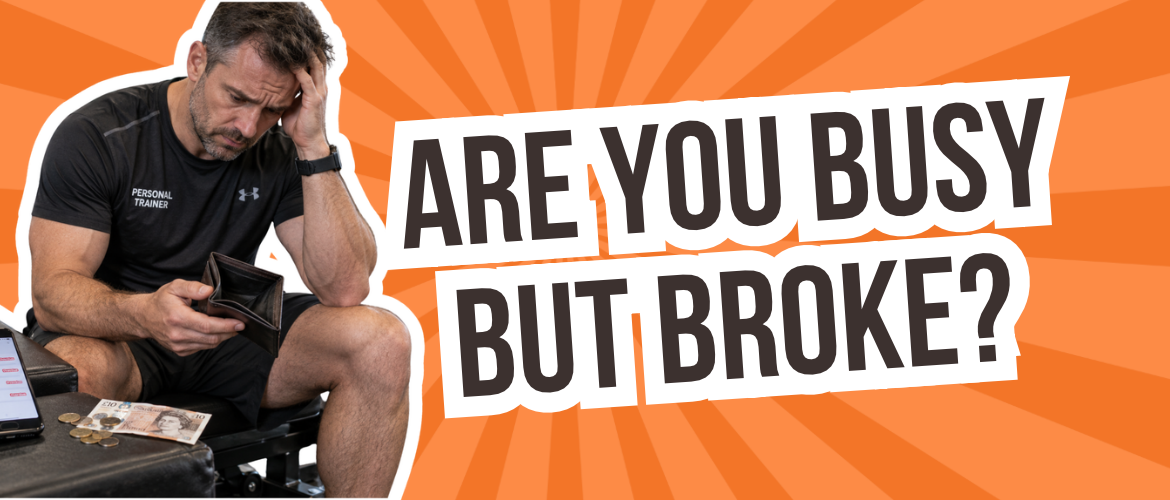
Are you building a profitable Personal Training business, or have you simply created yourself a low-paid job with no holiday pay, no sick pay and a boss who’s an absolute nightmare?
And before you ask, yes, that boss is you.
One of the biggest challenges facing newly qualified Personal Trainers is deciding how much to charge.
Too expensive, and you worry nobody will hire you. Too cheap, and you might find yourself working ridiculous hours just to make ends meet.
So, is £30 an hour enough to make a decent living as a Personal Trainer?
The answer depends on your circumstances. But there’s a common mistake that can make even a busy Personal Trainer struggle financially.
Welcome to the £30 Personal Trainer Trap.
Let’s imagine you’re a newly qualified Personal Trainer charging £30 per session.
You’ve managed to attract ten regular clients, each training twice a week.
That’s 20 sessions per week, generating £600.
Multiply that by 52 weeks, and you’ve got £31,200 a year.
Not bad, right?
Except there’s a problem.
Actually, several problems.
First, you’re probably not going to work 52 weeks a year. Unless you’ve developed an extraordinary immune system and decided that holidays are for the weak.
Let’s assume you deliver 20 sessions a week for 46 weeks.
That’s £27,600 in annual revenue.
But that’s revenue, not profit, and certainly not your take-home pay.
You still need to account for business expenses, taxes and all the hours spent working when you’re not actually training clients.
Depending on how you operate, your expenses might include:
And let’s not forget the seventeen subscriptions you’ve signed up for and can’t remember the passwords to.
Now consider the unpaid hours.
Writing programmes, replying to messages, managing appointments, marketing your business, meeting potential clients and doing admin.
Suddenly, those 20 sessions a week could mean considerably more than 20 hours of work.
The important question isn’t simply how much you charge per session. It’s how much you actually earn for every hour you work.
In my experience, there are three common reasons why new Personal Trainers undervalue themselves.
Many newly qualified trainers worry that nobody will pay them.
So they look around the gym and compare themselves with more experienced professionals.
They think:
“Dave charges £40, but he’s been doing this for five years. I’ll charge £25.”
Which is an interesting business strategy.
You’ve essentially told everyone that you’re not as good as Dave before anyone has even met you.
Of course, experience can justify different pricing. But being newly qualified doesn’t automatically mean you should be the cheapest trainer in the gym.
Clients are looking for someone who understands their needs, communicates effectively and can help them achieve their goals.
Price is only one part of that decision.
The fitness industry is full of comparison.
We compare qualifications, physiques, Instagram followers, client numbers and prices.
Unfortunately, we rarely know what’s actually happening behind the scenes of someone else’s business.
That Personal Trainer with 20,000 Instagram followers might have fewer paying clients than someone who barely posts online.
And the trainer charging £70 per session might have significantly higher overheads than someone charging £40.
Their business isn’t your business.
Before setting your prices, you need to understand your own expenses, target customers, service and financial goals.
This is perhaps the most interesting reason.
Many people become Personal Trainers because they genuinely want to help others.
At Storm Fitness Academy, we regularly work with students who want to improve people’s health, confidence and quality of life.
Some have experienced their own personal transformations and want to help others do the same.
These are wonderful reasons to become a fitness professional.
But sometimes that desire to help creates an uncomfortable relationship with money.
People begin to believe that charging a fair price somehow makes them greedy.
As though earning a decent living means they’ve stopped caring about their clients.
But think about it.
Doctors get paid.
Teachers get paid.
Physiotherapists get paid.
And nobody seriously argues that they should work for free simply because their profession involves helping people.
So why should Personal Trainers feel guilty about making a reasonable living?
Absolutely.
In fact, I’d argue that building a financially sustainable business can help you become a better coach.
When you’re constantly worrying about money, working excessive hours or desperately searching for new clients, it’s difficult to provide your best service.
You become stressed, exhausted and potentially resentful of the career you originally loved.
That isn’t good for your wellbeing.
And it isn’t particularly good for your clients either.
There’s an important distinction here.
Being generous isn’t the same as undervaluing yourself. And making a profit isn’t the same as exploiting people.
You can treat customers fairly, offer genuine value, provide excellent support and still charge enough to make a decent living.
Equally, charging more doesn’t automatically make you a better Personal Trainer.
Higher prices should be justified by the quality, scope and value of the service you deliver.
The goal isn’t to extract as much money from people as possible.
It’s to build a sustainable business that benefits both you and your clients.
Here’s another mistake I regularly see.
Personal Trainers advertise themselves like this:
“Personal Training, £30 per hour.”
And that’s their entire marketing strategy.
But think about what your customers actually want.
Nobody wakes up in the morning thinking:
“Do you know what would make my life complete? Paying a stranger to watch me perform lunges for sixty minutes.”
Most people aren’t looking for personal training sessions simply for the sake of having sessions.
They’re looking for solutions to problems.
They want to:
You’re not simply selling an hour of exercise. You’re offering professional support to help someone improve their life.
And when you understand that, the conversation changes.
Instead of competing purely on price, you can communicate the genuine benefits of your coaching service.
This doesn’t mean making unrealistic promises or guaranteeing results.
It means helping potential clients understand how your knowledge, guidance and support can help them work towards their goals.
So, should every Personal Trainer immediately double their prices?
Absolutely not.
Imagine me ringing all our newly qualified Storm graduates tomorrow.
“Congratulations on qualifying. You’re now charging £100 an hour. Good luck!”
That probably wouldn’t end particularly well.
Instead, I’d recommend three practical steps.
Before deciding what to charge, calculate how much you need your business to generate.
Consider your desired personal income, operating expenses, unpaid working hours and how many sessions you can realistically deliver.
Let’s compare three different session prices, using 20 paid sessions per week over 46 weeks.
| Session price | Weekly revenue | Annual revenue |
|---|---|---|
| £30 | £600 | £27,600 |
| £40 | £800 | £36,800 |
| £50 | £1,000 | £46,000 |
These figures are before business expenses and tax.
Notice the difference between charging £30 and £50.
At exactly the same number of sessions, that’s an additional £18,400 in annual revenue.
Of course, increasing your prices might affect demand, particularly if your customers are price-sensitive.
But the example demonstrates why pricing is such an important business decision.
You don’t necessarily need to work more hours to generate more income.
Sometimes you need to review what you’re charging and the value you’re providing.
Ask yourself:
For example, perhaps you specialise in helping people who feel intimidated by gyms.
Your ability to provide reassurance, build confidence, teach exercise technique and create a supportive environment could be particularly valuable to those clients.
Alternatively, perhaps you enjoy working with older adults who want to improve strength, mobility and independence.
The more clearly you understand your target audience, the easier it becomes to design and communicate a service that meets their needs.
If your entire income depends on selling individual hours, there’s a limit to how much you can earn.
You only have so many hours available.
And if you stop working, your income may stop too.
That’s why it’s worth exploring different ways of delivering your service.
For example:
Monthly coaching packages
Rather than charging for individual sessions, you could offer structured monthly programmes combining exercise sessions, progress reviews and appropriate support between appointments.
Small-group Personal Training
Working with small groups can make coaching more affordable for individual customers while potentially increasing your revenue per hour.
Hybrid coaching
Some clients may benefit from a combination of face-to-face training and remote programme support.
None of these approaches is automatically more profitable or suitable for every business.
But they demonstrate that selling individual sessions isn’t your only option.
The aim is to create a service that meets your customers’ needs while allowing you to earn a sustainable living.
There’s always someone willing to charge less.
If you’re charging £40, someone will charge £30.
If you’re charging £30, someone will charge £20.
And eventually, you’re competing with a bloke on YouTube giving away workouts for free while wearing a vest three sizes too small.
That’s a difficult battle to win.
Rather than trying to be the cheapest Personal Trainer, concentrate on becoming someone people genuinely want to work with.
Someone who’s knowledgeable.
Someone who listens.
Someone who communicates clearly.
Someone who’s reliable, honest and professional.
Someone who cares about helping people succeed.
Those qualities help build trust, relationships and a positive reputation.
And in a service-based industry like Personal Training, those things matter enormously
I don’t believe there’s anything wrong with wanting to make money.
And I certainly don’t believe that wanting to help people means you should sacrifice your own financial wellbeing.
You can be ambitious and ethical.
You can be successful and generous.
You can care about people and still charge a fair price for your expertise.
But there’s one important principle I’d encourage every aspiring Personal Trainer to remember.
Knowing your worth is important, but delivering value is what earns you the right to charge for it.
If you’re currently charging £30 per session, I’m not suggesting you need to increase your prices tomorrow.
That might be entirely appropriate for your circumstances.
Instead, ask yourself one simple question:
Is my pricing helping me build the business and lifestyle I actually want, or am I just keeping myself very, very busy?
Because being busy and being successful aren’t always the same thing.
At Storm Fitness Academy, we believe becoming a successful Personal Trainer involves much more than learning exercise techniques and writing training programmes.
You also need the confidence, communication skills and business knowledge to attract clients, deliver an excellent service and build a sustainable career.
Our Level 3 Personal Training qualification helps aspiring fitness professionals develop the practical knowledge and skills needed to start their careers.
Whether you’re completely new to the industry or considering a career change, we’re here to help you take the next step.
Explore our Personal Training qualifications and start building a career doing something you love.
Fill out the contact form below, and we will contact you shortly after.
"*" indicates required fields