GET IN TOUCH TODAY!
"*" indicates required fields

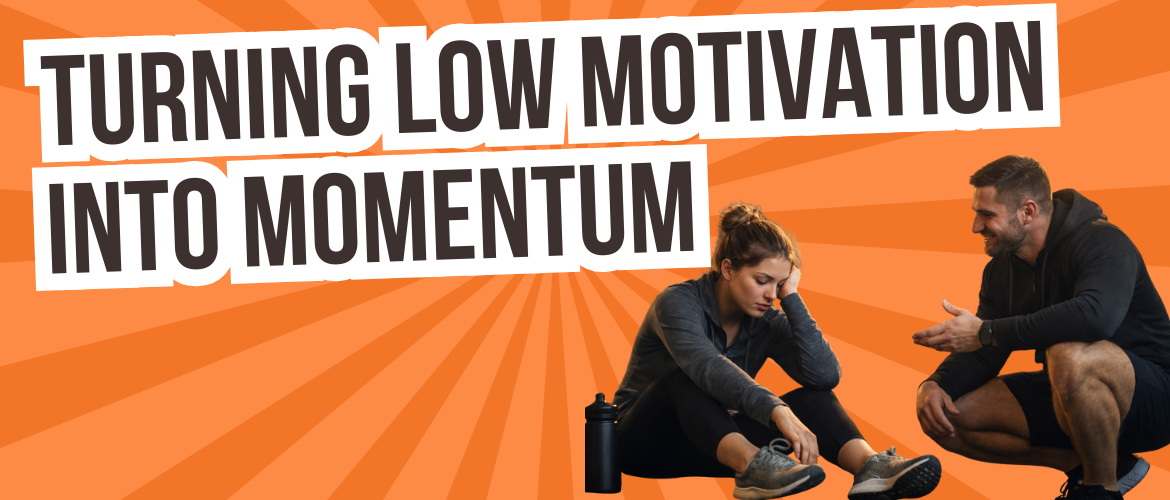
Every personal trainer experiences this moment at some point.
Your client walks into the gym looking half asleep, slightly annoyed, and clearly not thrilled about being there.
Maybe it is a 6 am session and they would rather still be in bed.
Maybe work stress has drained their energy.
Maybe they signed up full of enthusiasm but that initial motivation has faded.
Whatever the reason, the energy in the session feels flat.
You ask how they are and get a one word answer.
The warm up feels sluggish.
The effort during sets is minimal.
Inside your head you might be thinking:
“Why did they even book this session if they don’t want to train?”
But this moment is actually where great coaches separate themselves from average ones.
Motivating a disengaged client is not about shouting louder, pushing harder, or delivering a motivational speech.
It is about understanding human behaviour.
Motivation is rarely the starting point. It is usually the result.
And your job as a coach is to create the conditions where motivation can return.
Before trying to fix the situation, it helps to understand what might be happening psychologically.
Most clients are not intentionally being difficult.
There are several common reasons clients show up with low motivation.
Clients do not live inside the gym.
They are dealing with:
Work deadlines
Family responsibilities
Financial pressure
Poor sleep
Early morning clients are especially vulnerable to this.
At 6 am, their brain is not thinking about personal bests.
It is thinking about coffee.
When someone first starts training, motivation is often high.
They feel inspired, hopeful, and ready to change their life.
But this phase rarely lasts forever.
Once training becomes routine, the excitement fades and discipline must take over.
Many clients are not mentally prepared for this shift.
Sometimes low effort is not laziness.
It is self protection.
If a client believes they might fail at an exercise or struggle physically, they may subconsciously hold back.
Low engagement can sometimes be a shield against embarrassment.
If a programme feels too complex or physically exhausting, clients can mentally check out.
Instead of pushing through, they disengage.
This is not a motivation problem.
It is a programme design problem.
Many trainers respond to disengaged clients by trying to “pump them up”.
They start delivering motivational speeches.
“Come on! Let’s go! You’ve got this!”
But motivation is not something you can shout into existence.
In fact, if the client already feels tired or stressed, this approach can make them feel worse.
Instead, the goal should be to lower resistance.
Make the session feel achievable.
Make progress feel possible.
And help the client reconnect with why they started in the first place.
When someone feels low energy, the biggest obstacle is simply starting.
Instead of demanding intensity immediately, reduce the barrier.
Say something simple like:
“Let’s just start with five minutes and see how you feel.”
This approach removes pressure.
Once movement begins, energy often follows.
Momentum is a powerful psychological tool.
Great coaches adapt.
If a client arrives exhausted, forcing the original programme may be counterproductive.
Instead, modify the session.
Reduce volume slightly.
Focus on technique.
Introduce a fun challenge or variation.
The goal is not perfection.
The goal is engagement.
A slightly easier session that rebuilds momentum is far better than a technically perfect session that the client hates.
When a client seems disengaged, curiosity works better than pressure.
Instead of assuming the problem, ask simple questions.
“How has your week been?”
“How is your energy today?”
“What feels realistic for today’s session?”
These questions show empathy while also giving the client ownership.
Often clients open up once they feel understood.
Nothing restores motivation faster than progress.
But the progress needs to feel achievable.
If a client is struggling, aim for small wins.
A slightly heavier lift.
One extra repetition.
Improved technique.
Celebrate these moments.
Success creates confidence.
Confidence fuels motivation.
Sometimes clients forget why they started.
Life gets busy and the bigger picture fades.
This is where your role as a coach becomes powerful.
Remind them of their goals.
Not in a guilt driven way, but in a supportive way.
For example:
“You mentioned a few weeks ago you wanted more energy for playing with your kids. Every session like this is helping that.”
This helps reconnect the session to something meaningful.
One of the most important lessons for both coaches and clients is this:
Not every session will feel great.
Some workouts feel powerful and energising.
Others feel like a grind.
But consistency over time matters far more than temporary motivation.
Your role as a coach is not to create perfect sessions.
It is to create consistent ones.
When a client shows up tired, disengaged, or unmotivated, it can feel frustrating.
But these moments are actually an opportunity.
Anyone can coach when a client is motivated.
Real coaching happens when motivation is low.
When you help someone train on a day they did not feel like it, you teach them something powerful.
You teach them that progress does not depend on motivation.
It depends on showing up.
And that lesson often changes lives.
The best personal trainers understand these moments because they have experienced them personally.
You have probably had training sessions where you did not feel like going to the gym.
But you went anyway.
You moved.
You lifted.
You finished the session.
And afterwards you felt better.
This is exactly the lesson your clients are learning.
When trainers maintain their own training discipline, they become powerful role models.
Clients do not just hear advice.
They see it lived out.
If you are passionate about helping people improve their health, confidence, and performance, personal training can be an incredibly rewarding career.
But becoming a great coach involves more than just learning exercises. It involves understanding people, motivation, and behaviour.
If you want to develop these skills further:
Subscribe to the Storm Fitness Academy blog and podcast for weekly insights into coaching, training, and building a successful fitness career.
Or explore our courses at Storm Fitness Academy if you are thinking about becoming a personal trainer or taking your coaching skills to the next level.
"*" indicates required fields